

⚡ Key Takeaways
- Python is safe: It remains the #1 language for AI “glue code” and user interfaces.
- Rust is the foundation: It is replacing C++ as the engine behind fast Python tools (like Polars and Pydantic).
- Mojo is the future: With speeds up to 35,000x faster than Python, it is the top contender for high-performance AI hardware code.
For the last decade, Python has been the undisputed King of Data Science and AI. If you check the TIOBE index or GitHub stars, the snake is still sitting comfortably on the iron throne.
It is easy to see why. Python is the “English Language” of programming. It is readable, beginner-friendly, and has an infinite ecosystem of libraries. Whether you are building AI Agents or analyzing stock markets with Pandas, Python “just works.”
But in late 2025, the wind is changing. As AI models get larger and cloud bills get higher, developers are starting to notice Python’s one glaring weakness: Speed.
Two powerful challengers have entered the arena to exploit this weakness: Rust (the reliable engineer) and Mojo (the speed demon). Are we witnessing the end of an era? Let’s dive into the data.
The Core Problem: The “Two-Language” Trap
Historically, AI development has suffered from the “Two-Language Problem.”
- Research Phase: Data Scientists write code in Python because it’s fast to write.
- Production Phase: Engineers rewrite that same code in C++ because Python is too slow for real-time users.
This process is slow, expensive, and prone to bugs. The industry is desperate for a language that is easy to write (like Python) but fast to run (like C++). This is where our challengers come in.
Challenger 1: Rust (The Infrastructure Layer) 🦀
Rust is not exactly “new,” but its takeover of the Python ecosystem in 2025 has been nothing short of aggressive. You might be writing Python code right now, but underneath the hood, you are actually running Rust.
The “Rustification” of Python
The smartest developers in the world have realized that they don’t need to replace Python users; they just need to replace the Python engine. Look at the tools defining 2026:
- Polars: The dataframe library that is crushing Pandas in benchmarks? It’s written in Rust.
- Ruff: The linter that checks your code 100x faster than Flake8? Written in Rust.
- Pydantic V2: The library that powers almost every AI API? They rewrote their core in Rust and saw a 50x speed increase.
The Verdict on Rust:
Rust is not killing Python; it is saving it. It is becoming the concrete foundation that keeps the Python skyscraper from falling over. If you are a tool builder, you must learn Rust. If you are a tool user, you can stick with Python and enjoy the free speed boost.
Challenger 2: Mojo (The True Usurper) 🔥
If Rust is the supportive friend, Mojo is the one trying to steal the crown.
Created by Chris Lattner (the genius who built Swift and LLVM), Mojo makes a bold promise: It is a superset of Python. This means you can copy-paste your existing Python code into a Mojo file, and it (mostly) works—but it runs with the speed of C.
Why Mojo is Scary (for Python)
Mojo allows developers to “opt-in” to complexity. You can write simple scripts just like Python. But if you need to optimize a specific function, you can add types and memory management to make that single function run 35,000x faster.
In 2026, as we see more “Edge AI” (running models on your phone or laptop), this efficiency matters. Python burns battery life; Mojo sips it.
The Comparison: 2026 Landscape
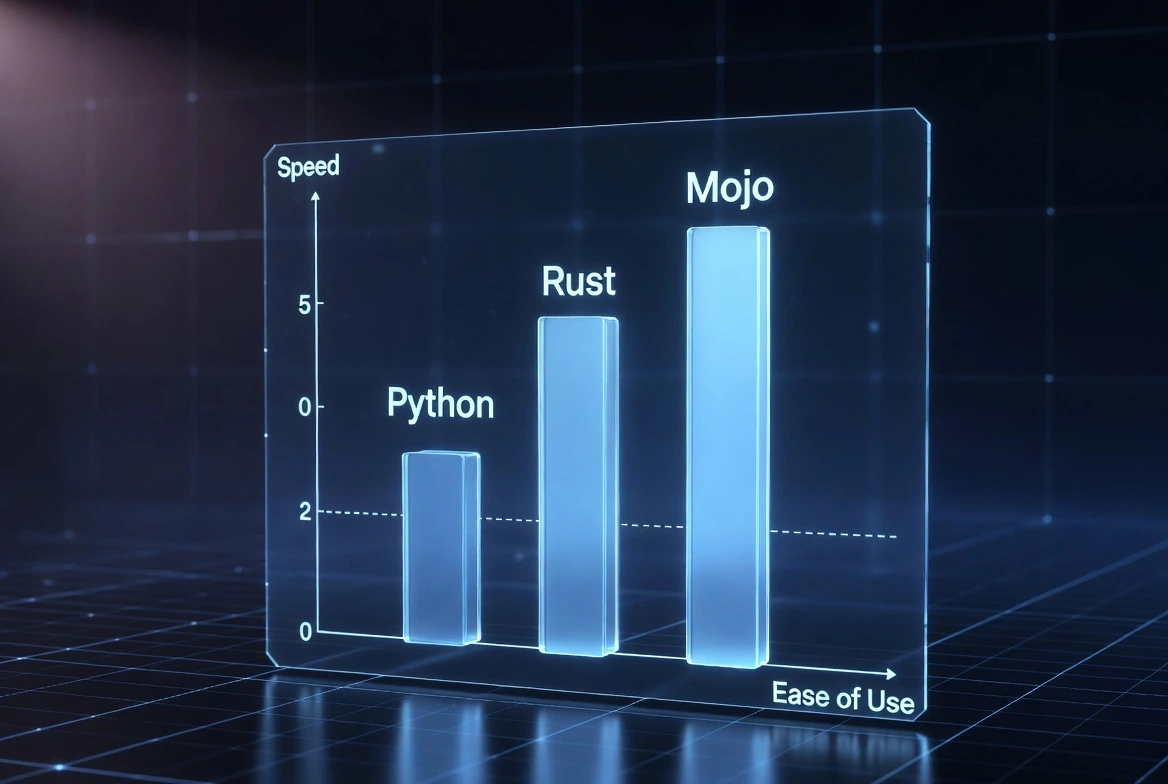
| Feature | Python 🐍 | Rust 🦀 | Mojo 🔥 |
|---|---|---|---|
| Primary Strength | Ease of Use | Memory Safety | Raw Speed |
| Learning Curve | Very Low (Easy) | Very High (Hard) | Medium |
| Best Use Case | Data Science, Scripts | Systems, Tooling | AI Hardware, GPU code |
So, Should You Stop Learning Python?
Absolutely not.
While the challengers are exciting, Python has one advantage that technology cannot replicate: Network Effects.
If you have a problem today, you can search StackOverflow and find a Python solution from 2018 that still works. If you want to hire a developer, there are millions of Python devs. If you want to connect a database to an LLM, the library is written in Python.
The Final Verdict
The King isn’t dead. He just hired some very fast bodyguards. Stay fluent in Python, but keep an eye on Mojo—it might just be the future.
Frequently Asked Questions
Will Mojo replace Python in 2026?
Not completely. Mojo is still maturing. While it offers incredible speed, the Python ecosystem (libraries like Pandas, NumPy, Scikit-learn) is too massive to be replaced overnight. Mojo is most likely to replace Python in high-performance areas first, like AI model training.
Is Rust harder to learn than Python?
Yes, significantly. Rust forces you to manage memory manually (borrow checking), which prevents bugs but makes the learning curve steep. Python handles memory automatically, making it much friendlier for beginners.
Can I use Python libraries in Mojo?
Yes! Mojo has a feature that allows you to import and run standard Python modules seamlessly. This is one of its biggest selling points over other fast languages like C++.
Why are Python libraries like Polars written in Rust?
Python is slow at “loops” and heavy calculations. By writing the core logic in Rust and wrapping it in Python, libraries like Polars get the best of both worlds: the speed of Rust and the ease of use of Python.